
News
1 June 2026: Start of issuance of a new generation of Slovenian passports
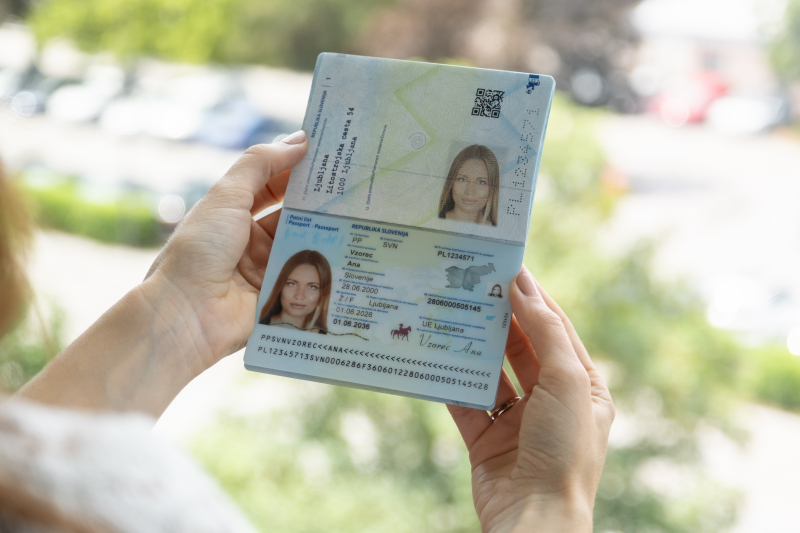
On 1 June 2026, the Republic of Slovenia started issuing a new, 5th generation of Slovenian travel documents. We are proud that all five generations of Slovenian passports have been produced by CETIS.
A passport is both a travel document and a document used to prove an individual's identity and citizenship at home and abroad, so its quality and protection against forgery and counterfeiting are of utmost importance for the security of the holder's identity. The new, fifth generation of Slovenian passports follows the advances in technology over the past ten years, while the design has also been modernised. The design still follows the overall graphic identity of Slovenian travel documents, thus ensuring the recognisability of the Slovenian passport abroad, and, in addition, approaches the latest version of the identity card, which is also produced by the company CETIS.
Valid passports do not need to be replaced, but citizens can do so if they wish. 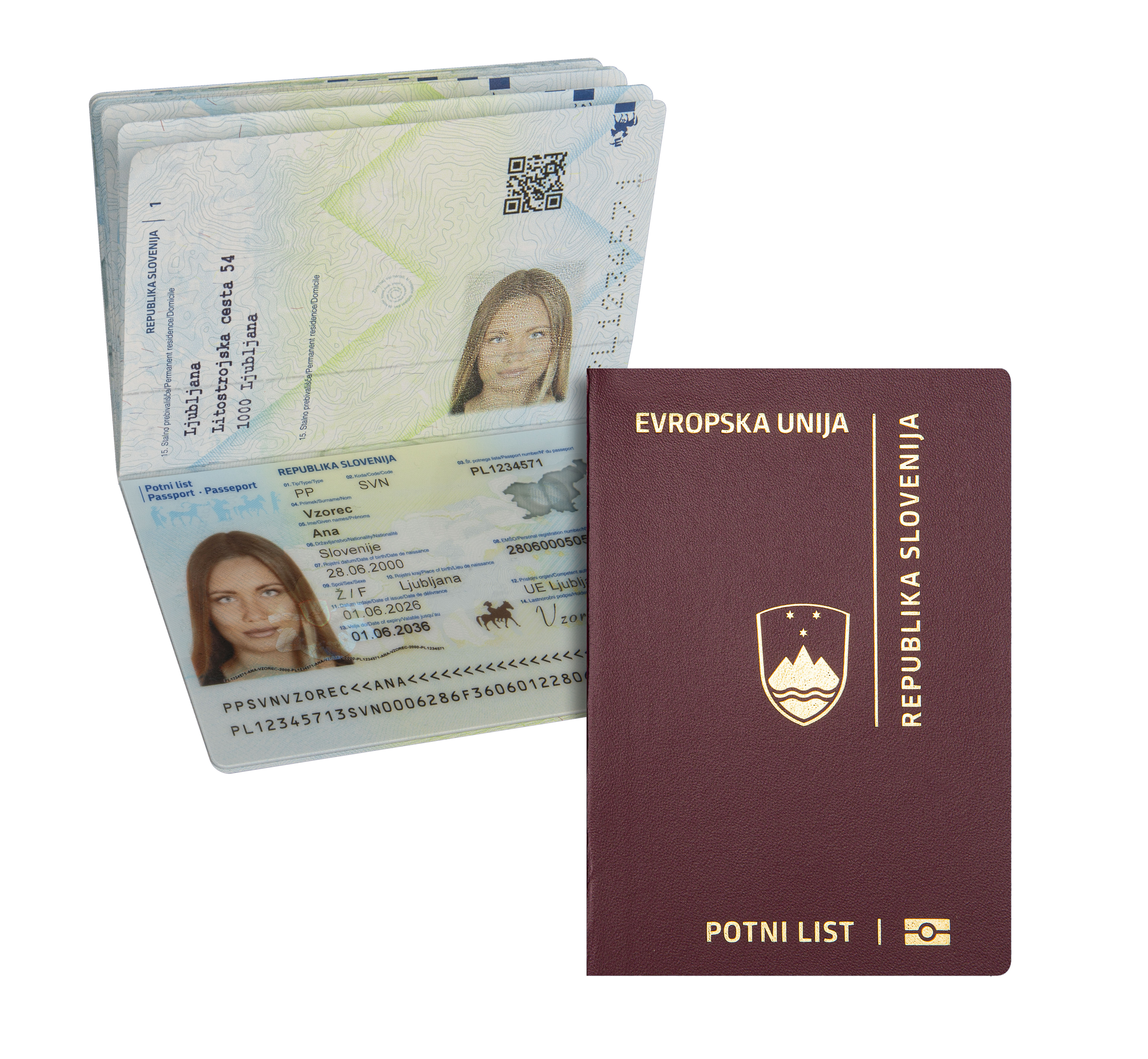
New, 5th generation of Slovenian travel documents | Photo: Ministry of the Interior and Public Administration
Design reflects the recognisable features of Slovenia
The design of the new passport reflects the distinctive characteristics of the Republic of Slovenia and highlights its national identity, cultural heritage and national symbols. The national symbols – the Slovenian coat of arms and the lyrics of the national anthem – are interlaced with motifs from Slovenian history, culture, architecture, geography and nature, which also serve as the basis for the incorporation of numerous security features.
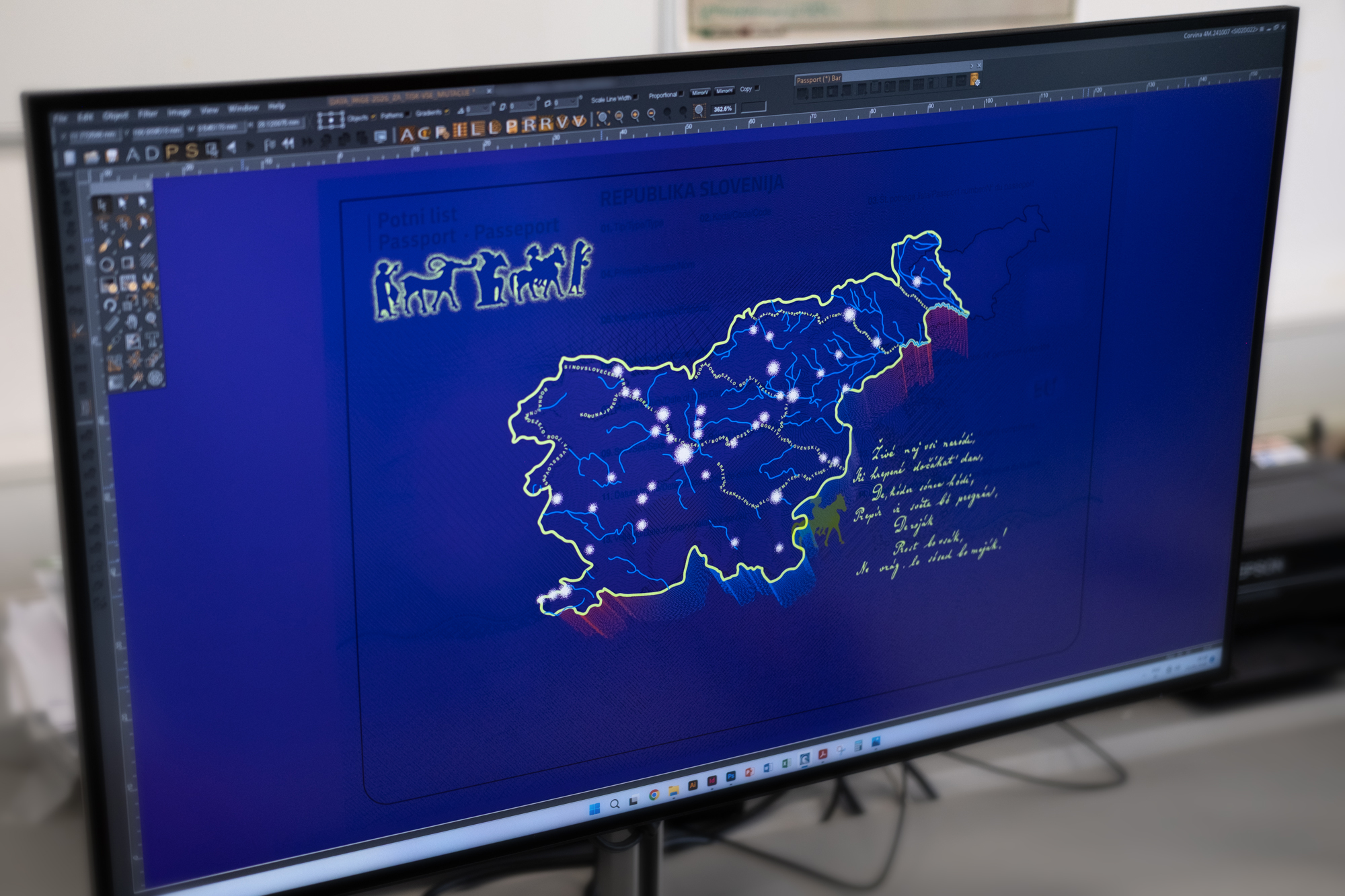
Outline of Slovenia with major cities and rivers embellished with the lyrics of Zdravljica (visible under UV light) | Photo: Ministry of the Interior and Public Administration
The use of Zdravljica, a poem by the greatest Slovenian poet, France Prešeren, plays a special role. In accordance with the Constitution of the Republic of Slovenia and a special law, the seventh stanza of Zdravljica serves as the lyrics of the Slovenian national anthem.
Zdravljica appears, both in the manuscript held by the National and University Library and in the transcript, in the form of various UV security features on every page of the passport, and in the form of microtext flowing along Slovenian rivers within the map on the document’s data page. The lyrics of the national anthem also appear in a spiral form and as a tactile relief element.
The current design trends are clearly reflected in the redesigned front cover. A new security feature has been added to the back cover – an embossed stylised image of Slovenia’s highest mountain, Triglav, which transitions into a curve symbolising the Slovenian sea and rivers, along with the inscription “SVN”, representing the universal three-letter code for Slovenia as defined by the international ISO 3166 standard.
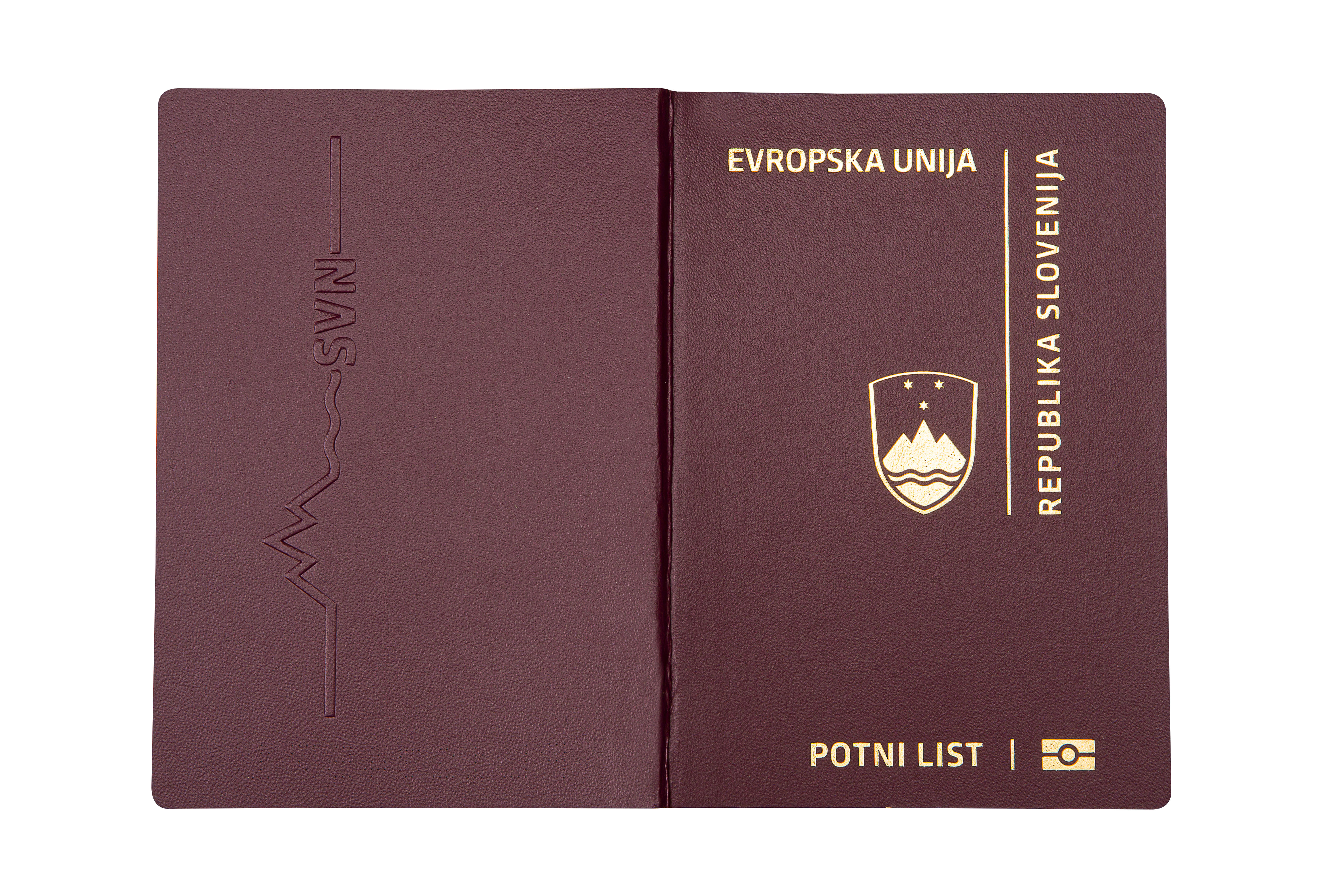 Coat of arms on the front cover. Stylised Triglav and the Slovenian sea and rivers with the international code "SVN” for the Republic of Slovenia on the back cover.| Photo: Ministry of the Interior and Public Administration
The graphic identity is enhanced with the changing triangular composition of Triglav, which appears as an intaglio background on the inside of the covers and throughout the visa pages. For the application of UV print and microtext, used in the background of the visa pages as guilloches are the contour lines representing Slovenia’s cartographic relief.
A powerful symbolic message is also conveyed through the motifs of the constellations of Cancer and Capricornus, which appear on the inside cover and in the hologram. The motifs represent the positions of the constellations of Capricornus on the day of the plebiscite, 23 December 1990, at which Slovenia chose to become an independent and sovereign state, and the constellation of Cancer on 25 June 1991, when Slovenia declared its independence.
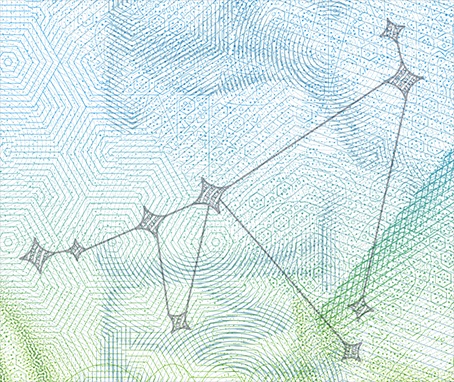
Capricornus constellation | Created by: Ministry of the Interior and Public Administration
Decorations from the Vače Situla are also used on the passport to incorporate security features, with an emphasis on the image of a horseman, which symbolises travel. The horseman appears in the optically variable ink (OVI) print and in the watermark, as well as next to the page numbers, where his mount appears to leap as the pages are flipped through quickly. The motifs of the linden leaf, which holds strong symbolic significance in Slovenia due to its association with national identity, tradition and community, and the outline of the Robba Fountain are also used.
The Vače Situla is a bronze ritual vessel from the 5th century BC, discovered in 1882 at Vače near Litija, not far from the geometric centre of Slovenia. It is decorated with three friezes depicting a ceremonial procession, sacrificial rites and animals, and is one of the most significant archaeological finds on Slovenian territory. The first frieze depicts a horseman, in a procession or accompanied by warriors, musicians and animals.

Inner cover: figures from the Vače Situla. | Photo: Ministry of the Interior and Public Administration
The Robba Fountain (the Fountain of the Three Carniolan Rivers) is Ljubljana’s most famous fountain. Made of white marble, it was completed in 1751. It was designed by Francesco Robba. It symbolises the Sava, Krka and Ljubljanica rivers.
The linden leaf is an important part of Slovenian national heritage. Important meetings have traditionally been held around round tables under linden trees.
The passport’s fresh look is achieved through a colour scheme of blue and green tones, which reflect the beauty of Slovenia’s natural landscape and are familiar to all citizens as the iconic colours of Slovenian sports, a unifying force for the Slovenian people, whose remarkable sporting achievements have put Slovenia on the world map. The colour scheme thus follows the design of the ID card.
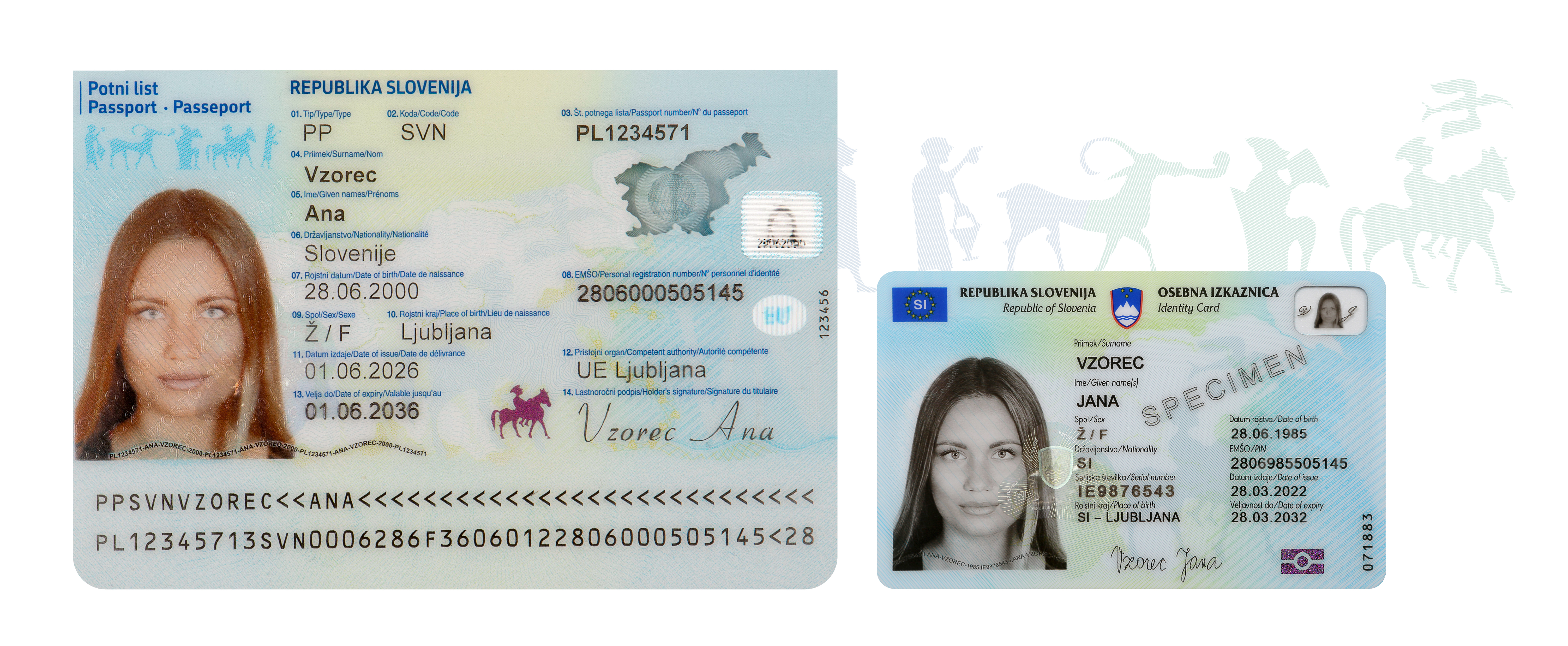 Comparison of the data page of the passport and the ID card. | Photo: Ministry of the Interior and Public Administration
The selection of motifs on the visa pages, which was created by renowned Slovenian graphic designer Miljenko Licul for the series of travel documents that began to be issued in 2001, remains unchanged. It covers various historical periods and sites in various parts of Slovenia. It has been given a fresh design in the new series of travel documents, and basic information about the motif and its location is also provided on each visa page.
Passport contains more than 100 security features
The various components (covers, polycarbonate data page, paper visa pages) of the passport contain more than 100 security features, which are seamlessly integrated into the document’s security design and interwoven into a cohesive visual narrative. The combination of state-of-the-art personalisation technologies ensures a high level of protection against forgery and abuse. Another significant technological advancement is the new solution for integrating the data page into the booklet in the form of 100% paperless polycarbonate, which significantly enhances the document’s security, durability and resilience.
A particularly notable security feature is a transparent window in the shape of the outline of the Republic of Slovenia. The transparent window is one of the most advanced additional security features, and is recommended by the International Civil Aviation Organization (ICAO). Its main advantage is simple and fast visual verification, and from the manufacturing perspective it is the interweaving of several complex technologies in one place that makes document forgery more difficult and increases resilience to abuse. The window also represents a security platform for upgrading with additional complex solutions (e.g. an embossed security feature with an optical effect and a security feature responsive to laser light).
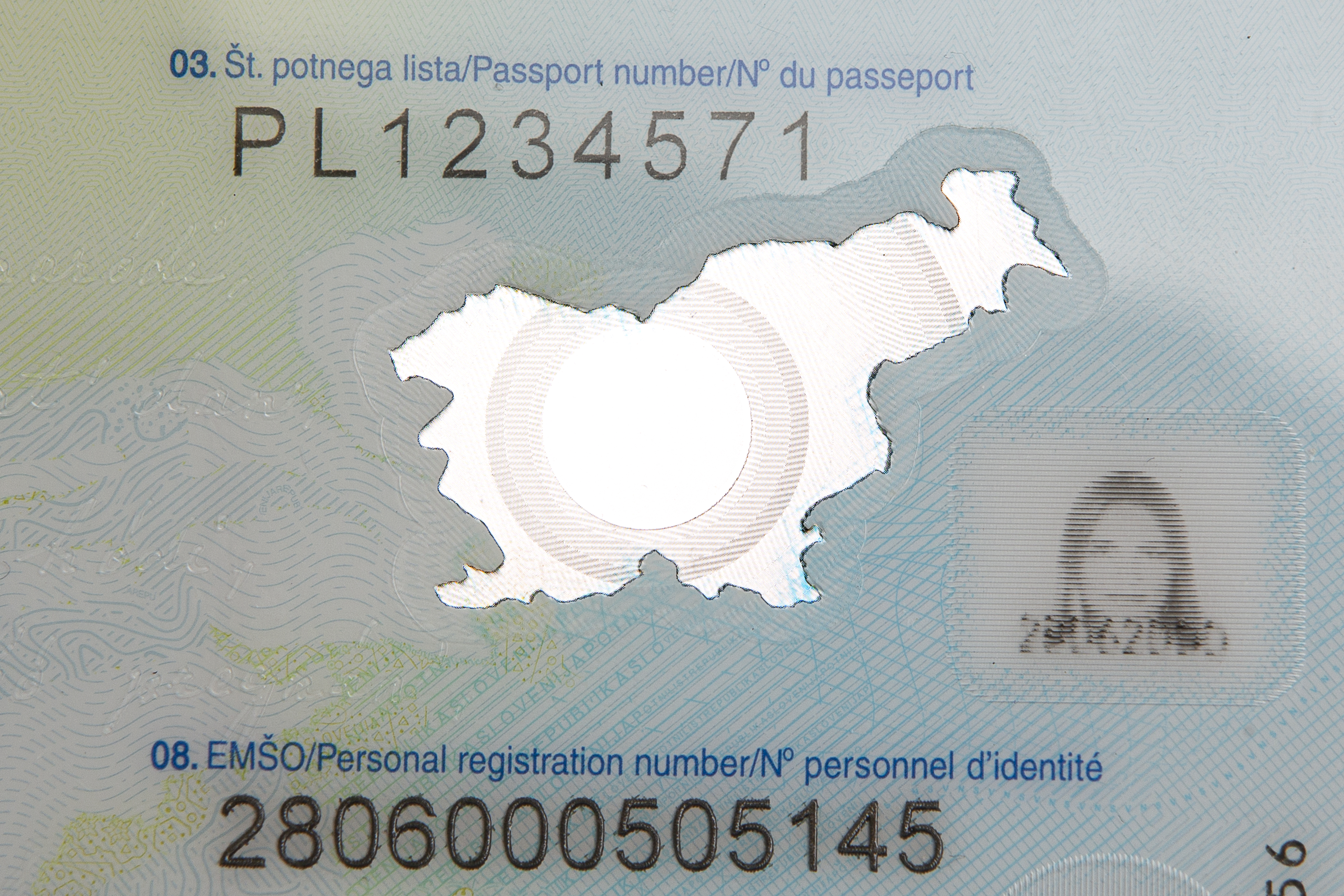
A transparent window in the shape of the outline of the Republic of Slovenia. | Photo: Ministry of the Interior and Public Administration
Colour image of a document holder used for the first time
Used in Slovenian documents for the first time is the technique of a colour photograph of the holder that is visible to the naked eye in three places. During the production process, each photograph is additionally protected with unique personal data. Information about the holder’s personal name and year of birth is inscribed across the photograph in UV-readable print, and the serial number of the passport is also visible on the holders’ neck.
The holder's image is depicted in five places in the passport using various personalisation techniques, specifically:
- information recorded on the chip;
- greyscale image with laser-engraved personalisation;
- colour image over greyscale with laser personalisation (even if the colour image is removed, there is a laser-printed greyscale version of the image below);
- Multiple Laser Image (the image of the document holder and their date of birth appear alternately);
- LetterScreen on the first inner page.
It is also visible through the transparent window on the data page back side.
The colour photograph in the passport represents a significant advancement in security and reliable identification of the document holder. It has become established in the security document industry in recent years with the development of advanced personalisation technologies.
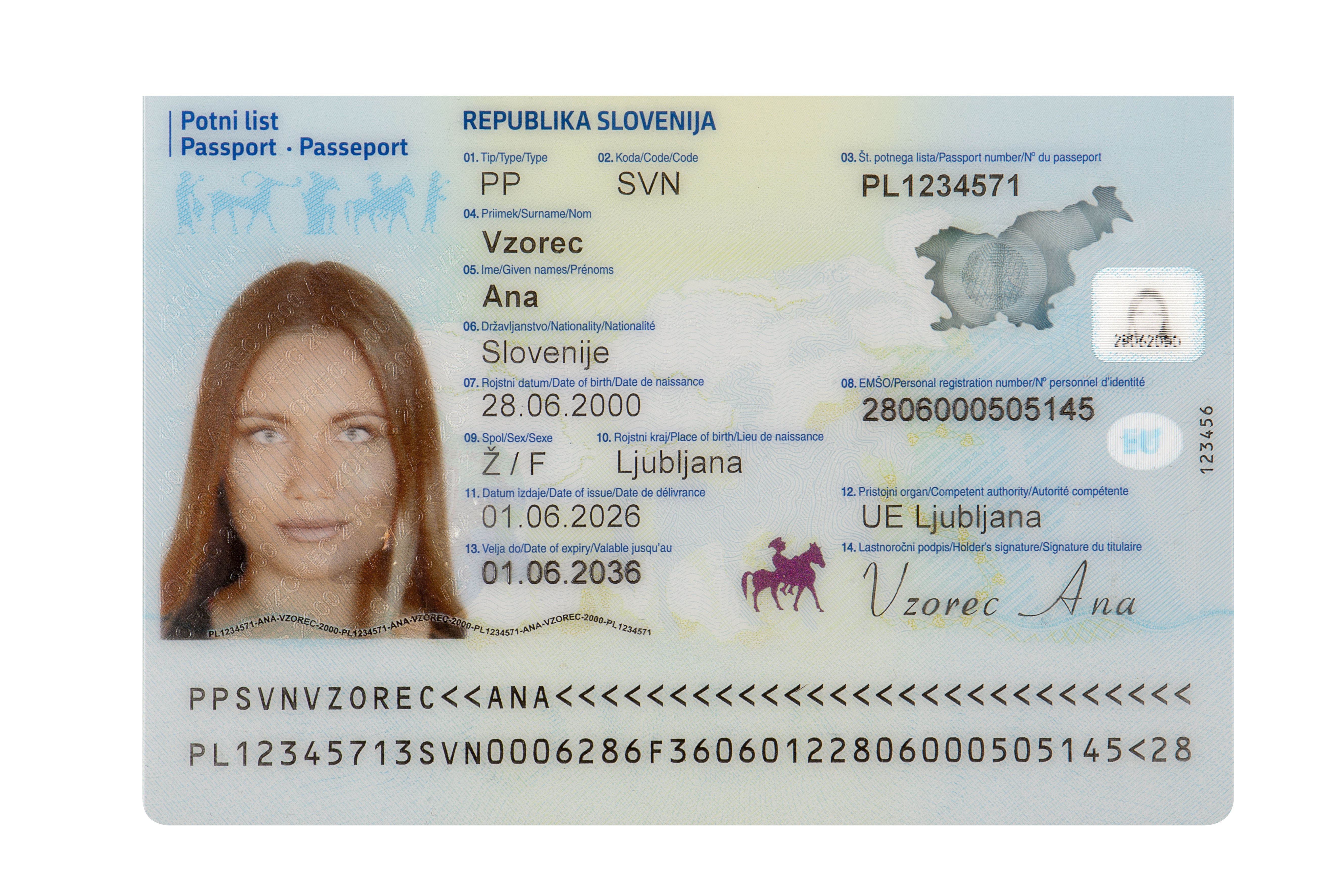 Technique of colour image of a document holder is used for the first time. | Photo: Ministry of the Interior and Public Administration
The main advantage of the colour photograph is significantly better visual identification of the person. The colour image allows for natural display of skin tone, eye and hair colour, and subtle facial features, enabling supervisory authorities to match the person to the document more quickly and reliably, even without using additional equipment. This significantly reduces the possibility of abuse due to different people looking similar in a black and white or grayscale photograph.
The colour photograph also enables the inclusion of additional advanced security elements, such as ultraviolet fluorescent components and infrared contrasts, which enables multi-layered verification of the document’s authenticity. Better interoperability with modern digital facial recognition systems is also an advantage, as these generally function more effectively with colour data.
The introduction of the colour photograph also means a more technologically demanding personalisation process, as it involves the use of several different technologies and additional checkpoints, which further complicates document counterfeiting. It is precisely the combination of higher security, more reliable identification and advanced technology that makes the colour photograph one of the key advantages of modern passports.
The new series eliminates the problem of poor serial number visibility, as this is no longer displayed as a Multiple Laser Image, but in a highlighted font.
QR code for checking passport validity
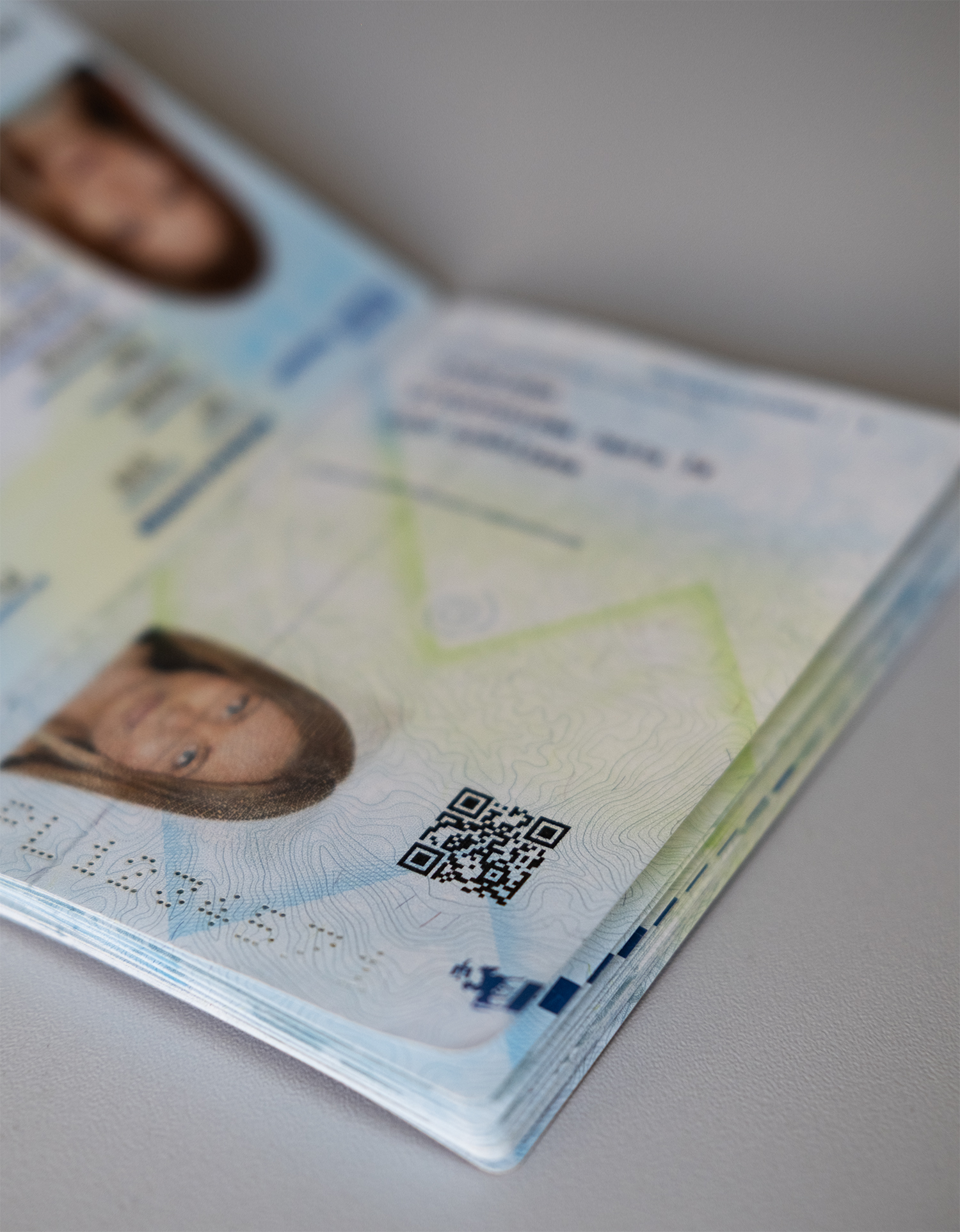 First inner page with a QR code for checking passport validity. | Photo: Ministry of the Interior and Public Administration
In the passport there is also a QR code next to the tertiary photo. This allows the validity of the passport to be checked. The purpose of the QR code is to enable the validity of the passport to be instantly checked when used at home and abroad. Scanning the QR code links the user (e.g. a bank) directly to the eGovernment website, where there is a search engine which, based on the type of document, its serial number and date of issue, enables the user to quickly obtain information on the validity of the document. This increases legal certainty.
The book edge design represents a modern and increasingly valued security feature of passports. Although it looks simple at first glance, it is a very technologically demanding security element that has begun to appear in the security document industry in recent years. The main advantage of the book edge design is simple and quick verification. When the passport is closed, under ultraviolet light, a uniform motif, i.e. continuous pattern (SVN), appears across the edges of all inner pages, an element that is very difficult to forge.
Such protection effectively prevents various types of document tampering, as it quickly shows whether individual pages have been removed or replaced. Any tampering interrupts the continuous pattern on the book edge, which enables quick detection of any manipulation of the document. In addition to the security function, the book edge design also contributes to the recognisability and modern appearance of the passport.
Passports are issued in seven versions
- Slovenian version of passport
- Slovenian/Italian version of passport
- Slovenian/Hungarian version of passport
- Diplomatic passport
- Official passport
- Aliens passport
- Passport for refugees
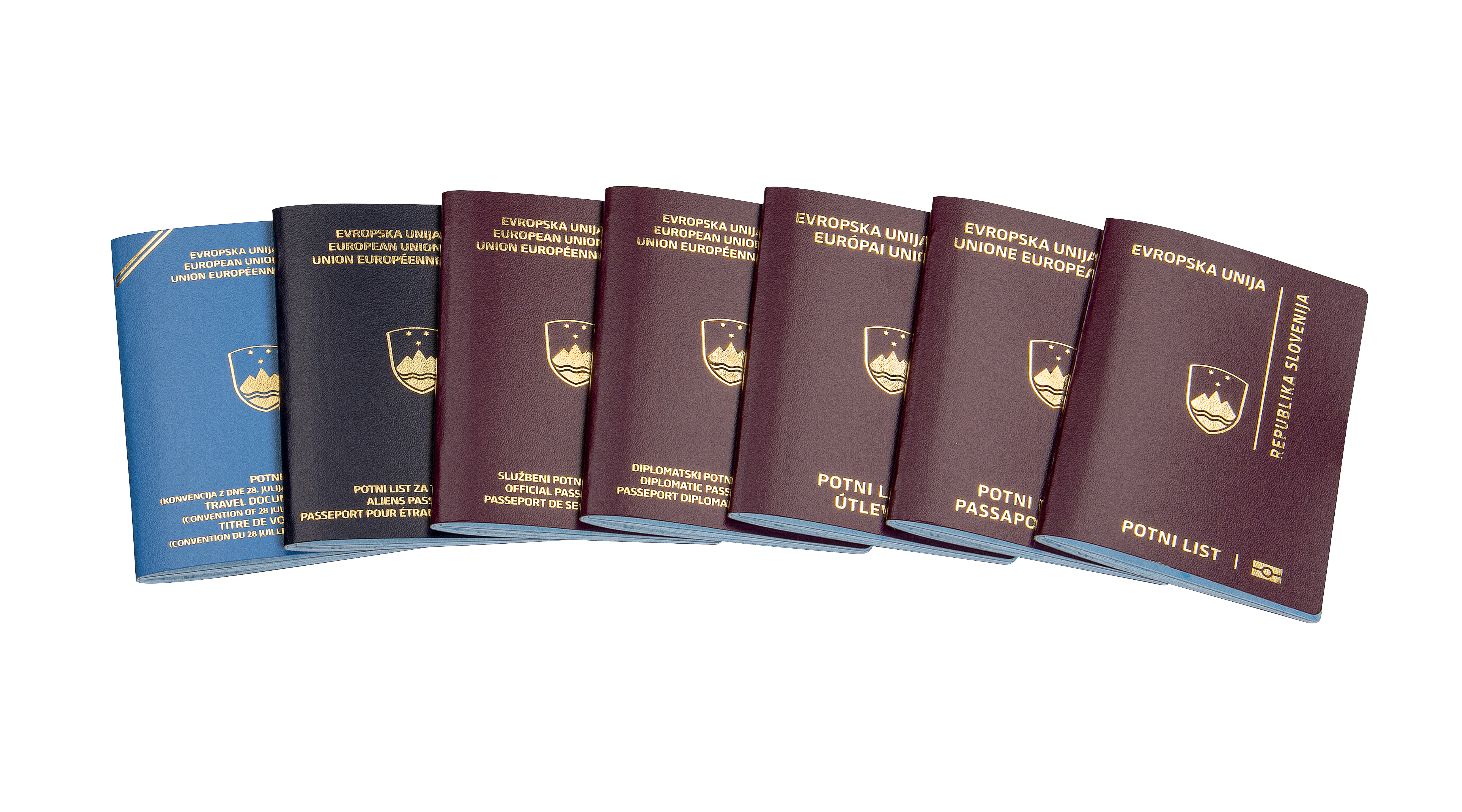 Passport versions | Photo: Ministry of the Interior and Public Administration
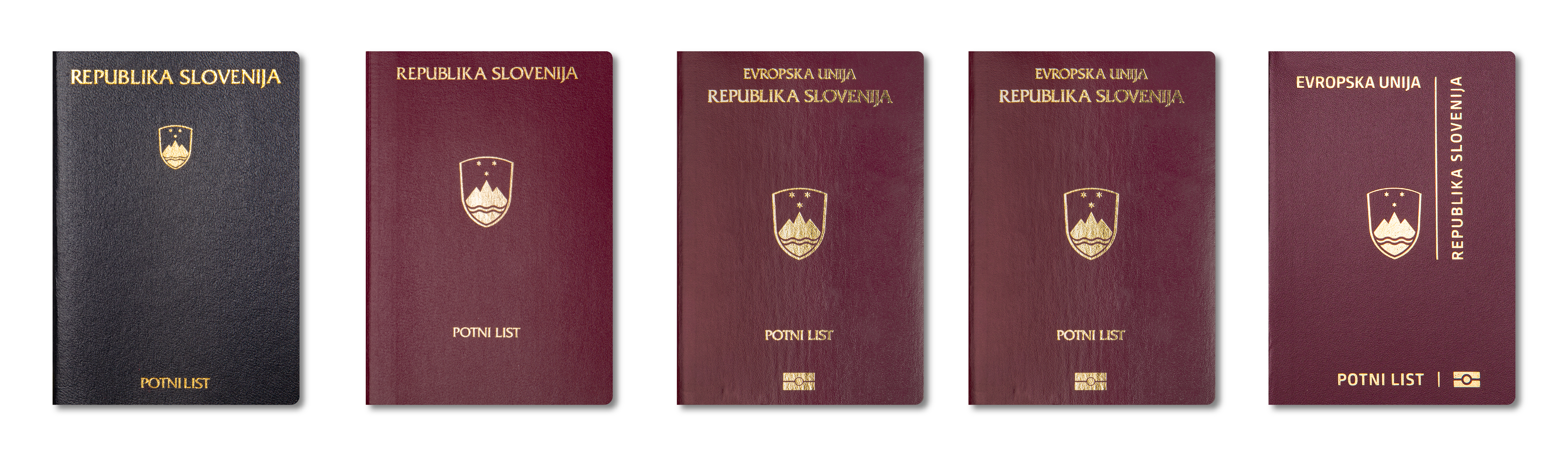 Covers of all five generations of passports produced by the company CETIS | Photo: Ministry of the Interior and Public Administration
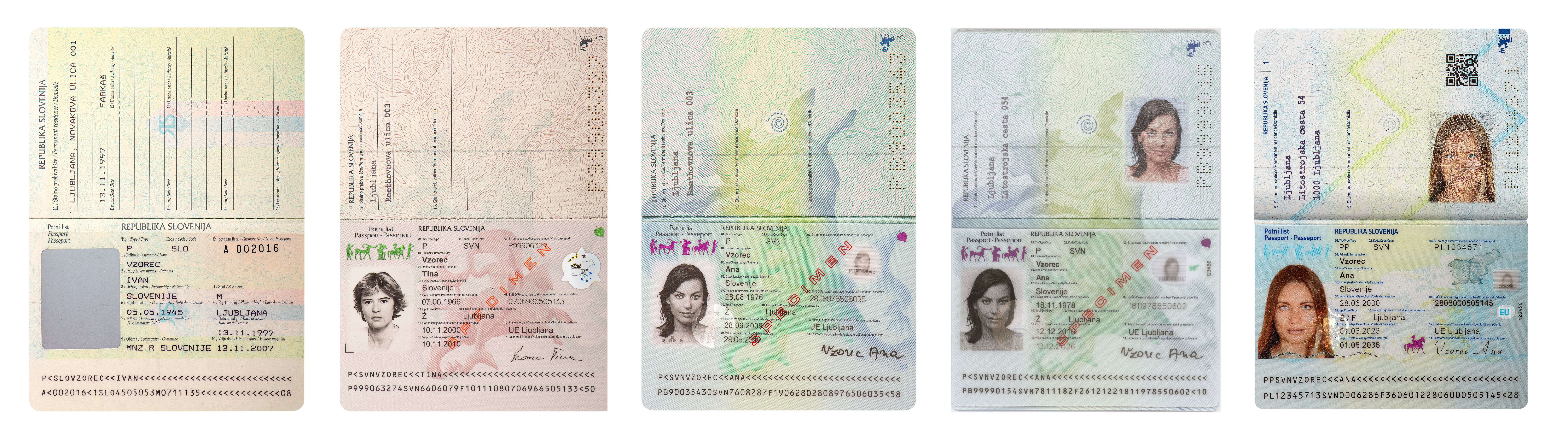 Data pages of all five generations of passports produced by the company CETIS | Photo: Ministry of the Interior and Public Administration